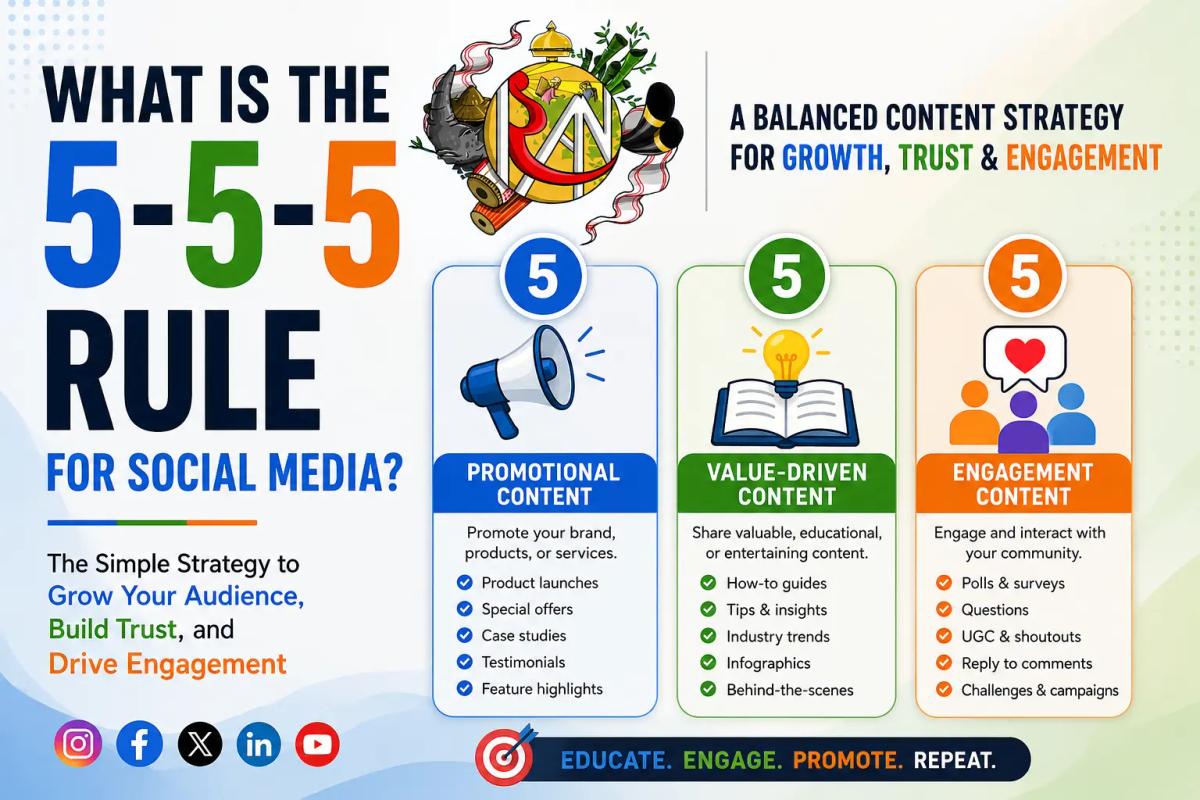
The Simple Strategy to Grow Your Audience, Build Trust, and Drive Engagement
If you have ever stared at a blank content calendar wondering what to post on social media, you are not alone. Many brands, marketers, and entrepreneurs struggle to strike the right balance between promoting their products and actually connecting with their audience. That is exactly where the 5-5-5 Rule for Social Media comes in.
This practical framework takes the guesswork out of social media content planning. By following a simple ratio, you can maintain a healthy mix of content that educates, engages, and converts — without coming across as pushy or one-dimensional.
In this article, we will break down exactly what the 5-5-5 rule is, why it works, how to apply it to your social media strategy, and tips to maximize its impact across different platforms.
What Is the 5-5-5 Rule for Social Media?
The 5-5-5 Rule is a social media content strategy that divides your posts into three equal categories of five. The idea is simple: for every 15 posts (or pieces of content) you share, five should serve each of the following purposes:
- 5 posts that promote your brand, product, or service
- 5 posts that share valuable, educational, or entertaining content
- 5 posts that engage and interact with your community
This balanced approach ensures that your social media presence feels human, helpful, and trustworthy — rather than a constant sales pitch. Think of it as a conversation: you listen, you share, and then you ask.
The 5-5-5 rule is versatile. Whether you are a small business owner, a content creator, or a marketing professional managing multiple brand accounts, this framework provides a reliable structure that keeps your content strategy on track.
Breaking Down Each Component of the 5-5-5 Rule
The First 5: Promotional Content
One-third of your content can and should promote your brand. This is the category most businesses default to — and often overdo. Under the 5-5-5 framework, promotional content is intentional and measured.
Promotional posts can include:
- Product launches or announcements
- Special offers, discounts, or sales
- Case studies and customer success stories
- Testimonials and reviews
- Service or feature highlights
Because promotional posts make up only a third of your content under this rule, your audience is far more receptive to them. You have already earned their trust and attention through the other two categories.
The Second 5: Value-Driven Content
This is the heart of any great social media strategy. Value-driven content is what makes people follow you, share your posts, and come back for more. It positions your brand as an authority in your niche and builds genuine goodwill with your audience.
Examples of value-driven posts include:
- How-to guides and tutorials
- Industry tips, trends, and insights
- Infographics and data visualizations
- Curated articles from credible sources
- Behind-the-scenes content and educational videos
The key question to ask before publishing: Does this post genuinely help or entertain my audience? If the answer is yes, it belongs in this category.
The Third 5: Community Engagement Content
The most overlooked category is engagement. Social media is not a broadcast channel — it is a two-way street. The third set of five posts is about fostering real conversations and making your followers feel seen and heard.
Engagement content can look like:
- Polls and surveys
- Questions posed to your audience
- User-generated content (UGC) reposts and shoutouts
- Responding to comments publicly
- Community challenges or interactive campaigns
Engagement content not only boosts your reach through social media algorithms (which favor posts with high interaction), but it also transforms passive followers into loyal brand advocates.
Why the 5-5-5 Rule Works
Social media algorithms consistently reward accounts that post a diverse range of content and generate genuine engagement. The 5-5-5 rule aligns perfectly with this reality. Here is why this framework is so effective:
- It prevents audience fatigue. When every post is a sales pitch, followers tune out. The 5-5-5 rule keeps your feed varied and interesting.
- It builds trust. Consistently providing value before asking for anything in return is the foundation of brand credibility.
- It improves algorithm performance. Engagement-focused posts signal to platforms like Instagram, LinkedIn, and Facebook that your content is worth showing to more people.
- It is easy to plan and execute. With a clear ratio to follow, content planning becomes far more structured and less stressful.
- It works across platforms. Whether you are on TikTok, LinkedIn, Instagram, X (Twitter), or Facebook, the principle of balanced content applies universally.
How to Apply the 5-5-5 Rule to Your Social Media Strategy
Implementing the 5-5-5 rule does not require a complete overhaul of your content strategy. Here is a step-by-step approach to get started:
- Audit your existing content. Look at your last 15 posts. How many were promotional? How many added genuine value? How many sparked conversation? Identifying imbalances is the first step.
- Create a content calendar. Plan your next 15 posts in batches. Assign five slots to each category before you start writing or designing.
- Develop a content bank. Build a library of value-driven and engagement posts so you always have material ready to publish.
- Schedule and automate where possible. Use tools like Buffer, Hootsuite, or Later to schedule your content in advance, ensuring consistency without daily pressure.
- Review and refine monthly. Check which posts performed best each month and adjust your content mix accordingly.
5-5-5 Rule Examples by Platform
The 5-5-5 rule adapts beautifully to different platforms. Here is how it might look in practice:
- Promotional: Product flatlay or launch Reel
- Value: A carousel post with tips related to your niche
- Engagement: A "This or That" poll in Stories or a question sticker
- Promotional: A case study highlighting client results
- Value: An industry trend breakdown or thought leadership article
- Engagement: A question post asking your network for their opinion on an industry topic
- Promotional: A limited-time offer or event announcement
- Value: A how-to video or shared blog article
- Engagement: A user-generated content repost or community poll
Common Mistakes When Using the 5-5-5 Rule
Even with a clear framework, there are pitfalls to watch out for:
- Treating the ratio as rigid. The 5-5-5 rule is a guideline, not a hard law. If a trending topic calls for more engagement posts one week, adapt accordingly.
- Neglecting quality for quantity. Posting to hit a number means nothing if the content is low quality. Each post should serve its category genuinely.
- Forgetting to actually engage. Posting engagement content is only half the job. You also need to respond to comments and participate in the conversations you start.
- Applying a one-size-fits-all approach. Adapt the content format and tone to each platform. What works on Instagram may not resonate on LinkedIn.
The 5-5-5 Rule vs. Other Social Media Content Frameworks
The 5-5-5 rule is one of several popular content ratio frameworks. Here is how it compares:
- The 80/20 Rule: 80% value-driven content, 20% promotional. The 5-5-5 rule is more balanced and encourages more direct engagement.
- The Rule of Thirds: Similar to 5-5-5, splitting content between promotion, value, and personal/engagement. The 5-5-5 version is more actionable with its specific numeric structure.
- The 4-1-1 Rule: Four educational or entertaining posts, one soft promotional post, one hard promotional post. The 5-5-5 rule gives more room for promotional content while maintaining strong community focus.
Each framework has its merits. The 5-5-5 rule stands out for its simplicity, balance, and the explicit emphasis on community engagement — making it particularly well-suited for brands looking to build long-term audience loyalty.
Pro Tips to Get the Most Out of the 5-5-5 Rule
- Repurpose content across categories. A blog post can become a value post, spark an engagement poll, and ultimately support a promotional campaign.
- Use analytics to refine your approach. Track which type of post generates the most reach, saves, shares, and clicks. Double down on what works.
- Batch-create your content. Dedicate one day each week or month to creating all 15 posts at once. Consistency is easier when content is prepared in advance.
- Stay current and relevant. Weave trending topics, seasonal events, and industry news into your value and engagement categories to keep content timely.
Conclusion
The 5-5-5 Rule for Social Media is a powerful yet simple framework that brings balance, intention, and structure to your content strategy. By dividing your posts into equal parts promotion, value, and engagement, you can build a social media presence that genuinely connects with your audience — and converts followers into loyal customers.
The brands and creators who thrive on social media are those who understand that success is not about shouting the loudest. It is about showing up consistently, offering real value, and building authentic relationships. The 5-5-5 rule gives you the roadmap to do exactly that.
Start with your next 15 posts. Split them into three groups of five. Commit to the framework for 30 days. You may be surprised by how quickly your engagement — and your community — begins to grow.
Key Takeaways
- The 5-5-5 rule splits your content into 5 promotional, 5 value-driven, and 5 engagement posts
- It prevents over-promotion and builds trust with your audience
- It works across all major social media platforms
- Community engagement content is often the most underestimated category
- Use a content calendar and analytics to plan, execute, and refine your 5-5-5 strategy