A Complete Guide to the Framework That Powers Successful Social Media Strategies
Social media marketing has evolved from a nice-to-have into an essential pillar of modern business growth. Yet despite its importance, many brands still approach social media without a clear, structured strategy — posting inconsistently, chasing trends without purpose, or measuring the wrong results.
That is where the 5 P's of Social Media Marketing come in. This powerful framework gives marketers, business owners, and content creators a clear roadmap for building a social media presence that is purposeful, consistent, and measurable.
In this article, we will explore each of the 5 P's in depth, explain why they matter, and show you exactly how to apply them to your social media strategy for maximum impact.
What Are the 5 P's of Social Media Marketing?
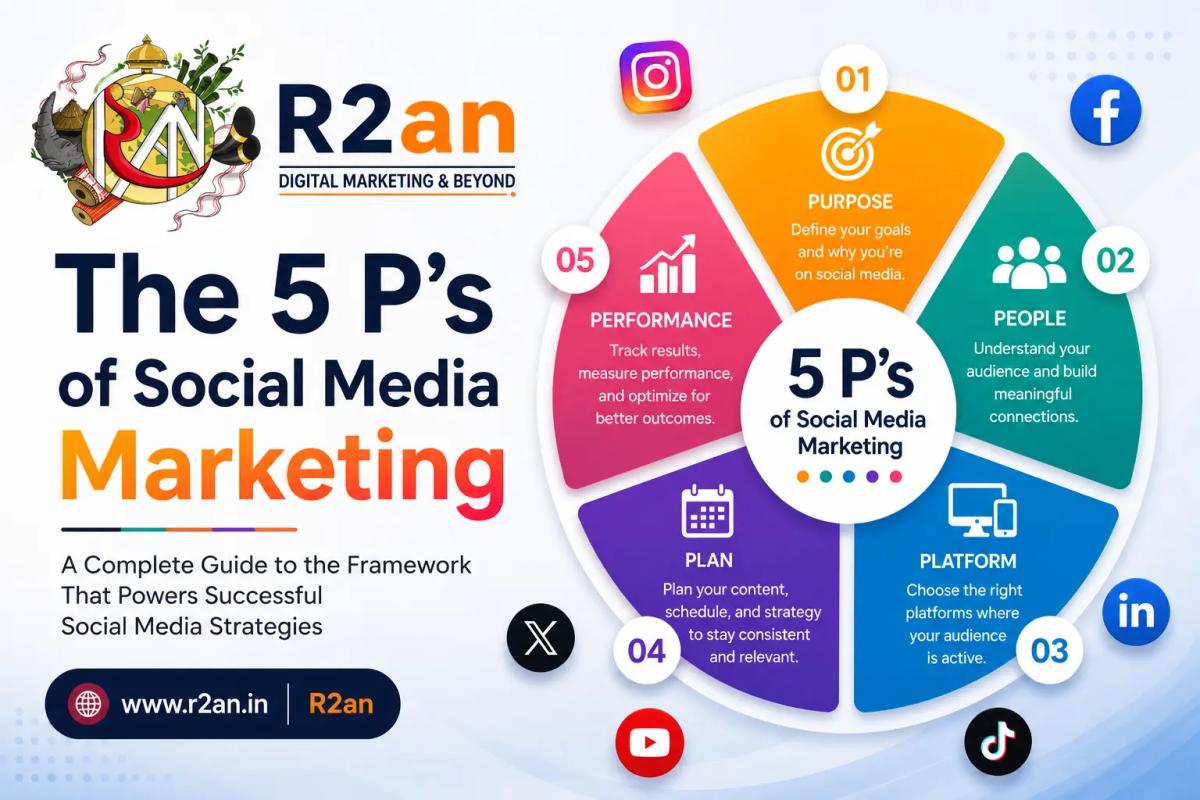
The 5 P's of Social Media Marketing are a strategic framework that breaks down the key elements required to build and sustain an effective social media presence. The five P's are:
- Purpose
- People
- Platform
- Plan
- Performance
Together, these five pillars address the who, what, where, how, and why of your social media efforts. Mastering each one is the difference between posting randomly and executing a strategy that drives real business results.
1. Purpose — Why Are You on Social Media?
Every successful social media strategy starts with a clearly defined purpose. Without purpose, your social media activity is just noise. With it, every post, story, and campaign becomes a deliberate step toward a meaningful goal.
Common social media purposes include:
- Building brand awareness and visibility
- Driving traffic to your website or landing pages
- Generating leads and converting prospects
- Providing customer service and support
- Establishing thought leadership in your industry
- Building and nurturing a loyal community
Your purpose should align directly with your broader business objectives. If your business goal is to increase revenue by 20% this year, your social media purpose might be to generate qualified leads or drive e-commerce conversions.
How to Define Your Social Media Purpose
- Start with your business goals and work backwards to identify how social media can support them.
- Write a one-sentence social media mission statement: "We use social media to [purpose] for [audience] so that [business outcome]."
- Revisit and refine your purpose quarterly as your business evolves.
2. People — Who Is Your Audience?
The second P is all about your audience — the people you are trying to reach, engage, and ultimately convert. No matter how polished your content is, it will fall flat if it is not crafted for the right people.
Understanding your audience goes far beyond basic demographics. Effective social media marketing requires a deep knowledge of your audience's psychographics: their interests, pain points, aspirations, online behaviors, and the type of content they respond to.
Key questions to answer about your people:
- Who are they? (age, location, occupation, income level)
- What problems do they need solved?
- What kind of content do they consume and share?
- When are they most active on social media?
- What tone, language, and format resonates with them?
Building Your Audience Persona
Create detailed buyer personas — semi-fictional representations of your ideal followers and customers. Give each persona a name, a background, specific goals, and common challenges. When creating content, write for your persona, not for a faceless crowd.
Use platform analytics (Instagram Insights, LinkedIn Analytics, Facebook Audience Insights) alongside customer surveys, reviews, and social listening tools to continuously refine your understanding of your people.
3. Platform — Where Does Your Audience Live?
Not every social media platform is right for every brand. The third P — Platform — is about choosing the right channels to reach your audience and aligning your content style to each platform's unique culture and format.
Spreading yourself thin across every platform is a common and costly mistake. It is far more effective to master two or three platforms where your audience is most active than to maintain a mediocre presence on six.
A quick overview of major platforms and their strengths:
- Instagram: Visual storytelling, lifestyle brands, e-commerce, influencer marketing. Strong for B2C audiences aged 18–44.
- LinkedIn: B2B marketing, professional networking, thought leadership, recruitment, and industry insights.
- Facebook: Community building, local business marketing, paid advertising, and reaching a broad demographic range.
- TikTok: Short-form video, viral content, reaching Gen Z and younger millennials with authentic, entertaining content.
- X (Twitter): Real-time conversation, trending topics, customer service, and engaging with media and tech communities.
- YouTube: Long-form video, tutorials, how-to content, and search-driven discovery through the world's second largest search engine.
How to Choose the Right Platform
- Find out which platforms your target audience uses most through research and analytics.
- Consider your content strengths — are you better at writing, video, photography, or audio?
- Research where your competitors are having the most success.
- Start with one or two platforms, build a strong presence, then expand strategically.
4. Plan — What and When Will You Post?
The fourth P is your content plan — the strategy that governs what you post, when you post it, and how it all fits together to serve your purpose and connect with your people on the right platforms.
A solid social media plan combines a content strategy, an editorial calendar, a posting schedule, and a set of brand guidelines. Without it, you are likely to fall into reactive, inconsistent posting — one of the most common reasons social media strategies fail.
Your social media plan should include:
- Content pillars: 3–5 core themes or topics your brand consistently covers. These keep your content focused and recognizable.
- Content mix: A balance of promotional, educational, entertaining, and community content. Frameworks like the 80/20 rule or the 5-5-5 rule can guide this.
- Posting frequency: Consistency beats volume. It is better to post three times a week reliably than seven times one week and nothing the next.
- Posting times: Use platform analytics to identify when your specific audience is most active and schedule posts accordingly.
- Brand voice and visual guidelines: Define your tone, vocabulary, color palette, and design style so every post feels cohesively on-brand.
Building a Social Media Content Calendar
A content calendar is the backbone of your social media plan. It maps out every post across your platforms for a set period — typically a month at a time. Plan your calendar at least two weeks in advance to give yourself time for quality creation without last-minute stress.
Tools like Trello, Notion, Asana, or dedicated social media platforms such as Buffer, Hootsuite, and Later make it easy to plan, schedule, and automate your content calendar across multiple channels.
5. Performance — How Do You Measure Success?
The final P is Performance — the process of tracking, measuring, and analyzing your results to understand what is working, what is not, and how to improve. Without performance measurement, your social media strategy is just guesswork.
Effective performance measurement starts with defining the right Key Performance Indicators (KPIs) — metrics that are directly tied to your purpose. A brand focused on awareness will track different metrics than one focused on lead generation or community building.
Common social media KPIs by goal:
- Brand Awareness: Reach, impressions, follower growth rate, share of voice
- Engagement: Likes, comments, shares, saves, engagement rate, mentions
- Traffic: Link clicks, website sessions from social, referral traffic
- Lead Generation: Form submissions, email sign-ups, cost per lead
- Conversions: Sales, revenue from social, conversion rate, return on ad spend (ROAS)
How to Build a Performance Review Routine
- Weekly check-ins: Review post-level metrics to identify which content is performing best or underperforming.
- Monthly reports: Assess overall channel growth, content category performance, and progress toward KPIs.
- Quarterly strategy reviews: Revisit your purpose, audience insights, platform choices, and plan based on what the data tells you.
- A/B testing: Continuously test different content formats, posting times, captions, and visuals to find what resonates most with your audience.
How the 5 P's Work Together
The real power of the 5 P's framework lies in how each element reinforces the others. They are not independent boxes to check off — they are interconnected pillars of a unified strategy.
- Your Purpose shapes everything — it informs who your People are and what success looks like for Performance.
- Your People determine which Platform you should invest in and what your Plan should contain.
- Your Platform choices influence the format and tone of your Plan.
- Your Performance data feeds back into all four other pillars, helping you refine your purpose, better understand your people, optimize your platform strategy, and strengthen your plan.
Why Use the 5 P's Framework?
The 5 P's framework is valuable because it forces strategic thinking before tactical execution. Most brands jump straight to "what should we post today" without first answering "why are we posting, who are we posting for, and where should we post it."
- It provides clarity. Everyone on your team understands the strategy, not just the tactics.
- It prevents wasted effort. You stop creating content for the sake of it and start creating content with intention.
- It scales with your business. Whether you are a solo entrepreneur or a marketing team of 20, the 5 P's framework is adaptable to any size or industry.
- It keeps you accountable. With performance built into the framework, you are always measuring and improving, never just hoping for the best.
Conclusion
The 5 P's of Social Media Marketing — Purpose, People, Platform, Plan, and Performance — offer a comprehensive framework for building a social media strategy that is grounded in intention and driven by results. Rather than reacting to trends or posting on a whim, the 5 P's give you a structured approach that connects your social media activity directly to your business goals.
Whether you are just starting out on social media or looking to level up an existing strategy, auditing your approach against each of the five pillars is one of the most productive exercises you can undertake. You may find that your purpose is unclear, your platform mix is off, or your performance tracking is missing entirely — and now you have the framework to fix it.
Start with Purpose. Know your People. Choose the right Platform. Build a smart Plan. And let Performance guide every decision you make going forward.