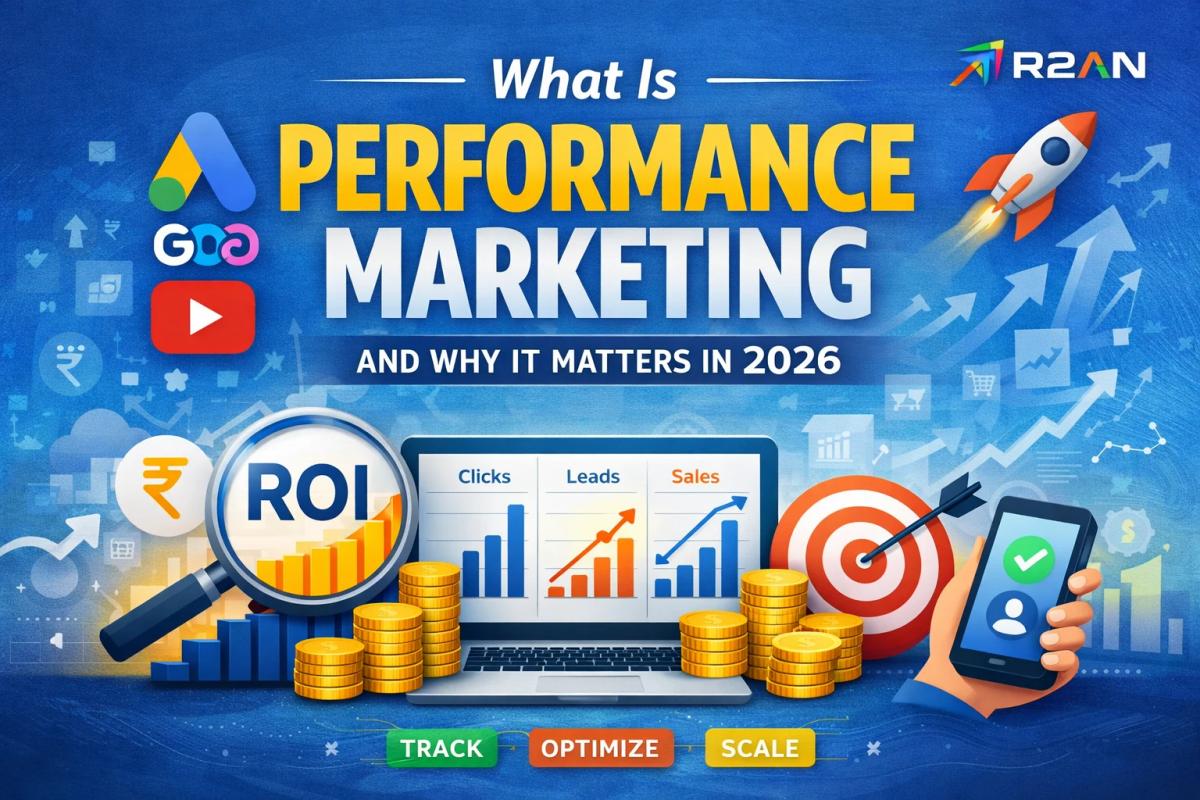
What Is Performance Marketing?
Performance marketing is a digital marketing strategy where businesses pay only for measurable results such as clicks, leads, or sales.
It is driven by data, analytics, and ROI-focused campaigns across platforms like:
- Google Ads
- Meta Ads (Facebook & Instagram)
- YouTube Ads
Unlike traditional marketing, performance marketing ensures every rupee spent is trackable and accountable.
What Is the Invisibility Tax?
The Invisibility Tax is the price businesses silently pay when they choose not to invest in marketing. It doesn’t show up on your balance sheet—but it shows up everywhere else: in missed opportunities, stagnant growth, and declining relevance.
When your brand isn’t actively marketing, you’re not standing still—you’re falling behind. You start losing potential customers to competitors, your market share begins to shrink, your brand fades from people’s minds, and you miss out on valuable data that could have fueled future growth.
Not spending on marketing isn’t saving money. It’s choosing to stay invisible—and paying for it in ways that compound over time.
Why Performance Marketing Is Important for Business Growth
Most businesses don’t struggle because of a bad product—they struggle because growth feels unpredictable.
One month, sales are good. The next, everything slows down. There’s no clear reason, no clear control.
That’s where performance marketing changes the game.
Instead of guessing, you start seeing exactly what works. Every campaign is measurable, every rupee is tracked, and ROI is no longer a hope—it’s a number you can improve. As you identify what brings in customers, you can scale it, turning customer acquisition into a predictable, repeatable system rather than a one-time win.
Over time, decisions stop being based on gut feeling and start being driven by real data. You know which audience converts, which creatives perform, and which channels deserve more investment.
And that’s when growth accelerates.
Because the businesses that invest in performance marketing aren’t just growing—they’re controlling how they grow, with a revenue pipeline they can forecast, optimize, and scale.
.How Performance Marketing Works (Step-by-Step)
- Audience Targeting: It starts with identifying your ideal customer—not just who they are, but how they behave, what they search for, and what drives their decisions.
- Ad Creation: Based on that insight, we create high-converting ads that are designed to capture attention and push users to take action, not just scroll past.
- Campaign Launch: These ads are then deployed across platforms like Meta, Google, and YouTube to reach the right audience at scale.
- Tracking & Analytics: Once live, every interaction—clicks, leads, and sales—is tracked to understand exactly what’s working.
- Optimization: Using real-time data, campaigns are continuously refined to improve performance, reduce costs, and increase conversions.
- Scaling: When a campaign proves profitable, budgets are increased strategically to amplify results and drive consistent growth.
This structured approach turns marketing from a guessing game into a repeatable, scalable growth engine.
The Core Formula Behind Growth
At the center of every scalable business is a simple truth—growth is not random, it’s mathematical.
LTV > CAC = Profitable Growth
- LTV (Lifetime Value): This is the total revenue a customer generates for your business over time. The higher it is, the more valuable each customer becomes.
- CAC (Customer Acquisition Cost): This is what you spend to acquire one customer through marketing and sales efforts. The lower it is, the more efficient your system becomes.
When your LTV is greater than your CAC, every customer you acquire adds profit to your business instead of draining it. That’s when marketing stops feeling like an expense and starts working like an investment.
This is why performance marketing matters—because it gives you the ability to control both sides of the equation. You can optimize campaigns to reduce CAC, while improving retention and customer experience to increase LTV.
And once this balance is achieved, scaling is no longer risky—it’s logical. Businesses that understand this don’t wait or hesitate. They invest confidently, because they know every rupee spent is designed to bring back more.
Why Relying Only on Product Quality Is Risky
Many businesses assume that if the product is good enough, it will naturally find its audience.
But markets don’t work like that.
- Running targeted ads: Your competitors are constantly putting their product in front of the right audience, ensuring they stay visible while you remain unnoticed.
- Capturing leads daily: They’re not waiting for customers to come—they’re actively building a pipeline of potential buyers every single day.
- Using data to optimize campaigns: Every campaign they run teaches them something, helping them improve faster, reduce costs, and increase conversions over time.
This is why the brands that win are not always the best—they’re the most visible and the most consistent.
Even with a superior product, if you’re not actively marketing, you’re giving your competitors the advantage. And over time, visibility compounds—making it harder to catch up the longer you wait.
Key Performance Marketing Metrics You Must Track
In performance marketing, growth doesn’t come from guesswork—it comes from knowing exactly what your numbers are telling you.
- ROAS (Return on Ad Spend): Shows how much revenue you generate for every rupee spent, helping you understand if your campaigns are actually profitable.
- CPA (Cost Per Acquisition): Tells you how much it costs to acquire one customer, giving you clarity on efficiency and sustainability.
- CTR (Click-Through Rate): Measures how many people click on your ad after seeing it, indicating how compelling your creatives and messaging are.
- LTV (Lifetime Value): Reveals how much revenue a customer brings over time, helping you decide how much you can afford to spend on acquisition.
- CAC (Customer Acquisition Cost): Captures the overall cost of acquiring a customer across all channels, giving a complete picture of your marketing spend.
When you track these metrics consistently, decisions become clearer, risks become calculated, and growth becomes scalable.
Because in performance marketing, if you can’t measure it—you can’t improve it, and you definitely can’t scale it
Does Performance Marketing Really Work?
A lot of businesses hesitate before investing in marketing—not because they don’t believe in growth, but because they’re unsure if it will actually deliver results.
The truth is, performance marketing works—but only when it’s done right.
- Reduces wasted spend: Instead of blindly spending, you invest in campaigns where every rupee is tracked and optimized, cutting down unnecessary losses.
- Improves targeting accuracy: Over time, data helps you reach the exact audience that is most likely to convert, rather than guessing who might be interested.
- Increases conversion rates: With continuous testing and optimization, your campaigns get better—turning more clicks into actual customers.
- Builds long-term growth systems: It’s not just about short-term sales; performance marketing creates a system that keeps improving and scaling over time.
The problem isn’t marketing.
It’s untracked marketing—where money is spent without clarity, direction, or measurable outcomes.
What R2AN Does
- Paid Media (Meta, Google, YouTube): It starts with visibility—we put your brand in front of the right people, at the right time, where attention actually exists.
- Performance Creatives: Then we make sure that attention converts, using creatives built to drive clicks, leads, and sales—not just impressions.
- Lead Generation Systems: As interest builds, we turn it into a steady flow of qualified leads your business can rely on.
- Attribution & Analytics: Behind the scenes, we track every action, so you always know what’s working and where your money is going.
- Retargeting Strategies: We don’t let potential customers slip away—we bring them back and convert them at a lower cost.
- E-commerce Growth: And finally, we scale what works—turning traffic into consistent revenue and one-time buyers into repeat customers.
Stop Paying the Invisibility Tax
If your brand isn’t growing, it’s not because marketing is expensive — it’s because invisibility is.
Start investing in performance marketing. Start scaling.
Final Takeaway
Marketing is not an expense — it is a growth investment that directly impacts revenue, visibility, and scalability.
Businesses that don’t invest in marketing:
- Remain invisible
- Lose market share
- Grow slower than competitors